ADA Parking Lot Striping Standards: Dimensions & Markings

Getting ADA parking lot striping standards wrong isn’t just a cosmetic issue, it’s a legal liability. Fines for non-compliant accessible parking spaces can reach thousands of dollars per violation, and lawsuits from advocacy groups are more common than most property managers realize. Whether you’re restriping an existing lot or laying out a brand-new one, the dimensions, slopes, signage, and markings all need to meet specific federal and state requirements.
At Sunset Facility Management, we handle asphalt and concrete services, including parking lot striping, for commercial, industrial, and institutional properties across New Jersey, Delaware, and Pennsylvania. Our crews are OSHA-10 certified, and we see firsthand how often parking lots fall out of compliance due to faded markings, incorrect dimensions, or missing access aisles. Small oversights lead to big problems.
This article breaks down the exact measurements, marking specifications, and layout rules you need to follow for ADA-compliant parking spaces. We’ll cover stall widths, access aisle dimensions, signage placement, slope tolerances, and how to calculate the correct number of accessible spaces for your lot size.
Why ADA parking striping standards matter
The Americans with Disabilities Act has been federal law since 1990, and parking lot compliance falls under Title III for places of public accommodation and Title II for government entities. Ignoring ADA parking lot striping standards puts your property at real legal and financial risk. The Department of Justice enforces these requirements, and complaints can trigger investigations, mandatory remediation, and civil penalties.
Legal and financial consequences
Fines for ADA violations can reach $75,000 for a first offense and up to $150,000 for repeat violations under federal civil penalty guidelines. Beyond government enforcement, private citizens and disability advocacy organizations have the right to sue directly. These lawsuits often target parking lots because non-compliant spaces are visible, measurable, and easy to document.
A single complaint filed with the Department of Justice can trigger a full accessibility audit of your entire property, not just the parking lot.
Common parking lot issues that trigger ADA complaints include:
- Faded or missing ISA (International Symbol of Accessibility) markings
- Access aisles that are too narrow or completely absent
- Incorrect slope in the parking space or aisle
- Missing or improperly placed signage
The impact on people who use your facility
Accessible parking isn’t just a legal checkbox. People with mobility impairments depend on correctly striped spaces to exit and enter their vehicles safely. An access aisle that’s too narrow or missing entirely forces wheelchair users into traffic lanes. Your tenants, customers, or visitors with disabilities notice when a lot is non-compliant, and that affects whether they return or recommend your property.
Proper striping also protects you from liability tied to poorly marked zones. Clear, well-maintained markings reduce confusion for all drivers and create a safer environment overall. When markings fade or lines shift due to repaving, even previously compliant lots fall out of standard quickly, and staying ahead of that degradation is far cheaper than fixing a violation after a complaint.
The official ADA rules that govern striping
The primary source for ada parking lot striping standards is the 2010 ADA Standards for Accessible Design, published by the Department of Justice. These standards replaced earlier 1991 guidelines and set the current binding requirements for parking facilities covered under the ADA. If your property received permits after March 15, 2012, you must comply with the 2010 standards.
The 2010 ADA Standards and the Access Board
The 2010 standards draw from guidelines developed by the Access Board, a federal agency that creates accessibility criteria under both the ADA and the Architectural Barriers Act (ABA). For federally funded or occupied facilities, the ABA Accessibility Standards apply instead of, or alongside, ADA requirements. Both documents share nearly identical parking specifications, so the core striping dimensions remain consistent regardless of which standard governs your property.
Always confirm whether your facility falls under ADA, ABA, or both before finalizing your striping plan.
State and local requirements
Some states add striping requirements beyond federal minimums, and your local municipality may enforce additional rules through building codes or zoning ordinances. New Jersey, Pennsylvania, and Delaware each maintain their own accessibility regulations. Check with your local authority before restriping to avoid having to redo otherwise compliant work. Key sources to verify include:
- Your state’s department of community affairs
- Local municipal building or zoning office
- Your property’s certificate of occupancy documentation
Required number and placement of spaces
The 2010 ADA Standards set minimum ratios for accessible parking based on your lot’s total capacity. These ratios apply to each individual lot or parking structure, not across your entire facility if you operate multiple separate lots. Calculate each lot independently to determine how many accessible spaces it requires.
How lot size determines space count
Section 208.2 of the 2010 ADA Standards defines the minimum number of accessible spaces required per lot. The table below gives you a quick reference for common lot sizes:
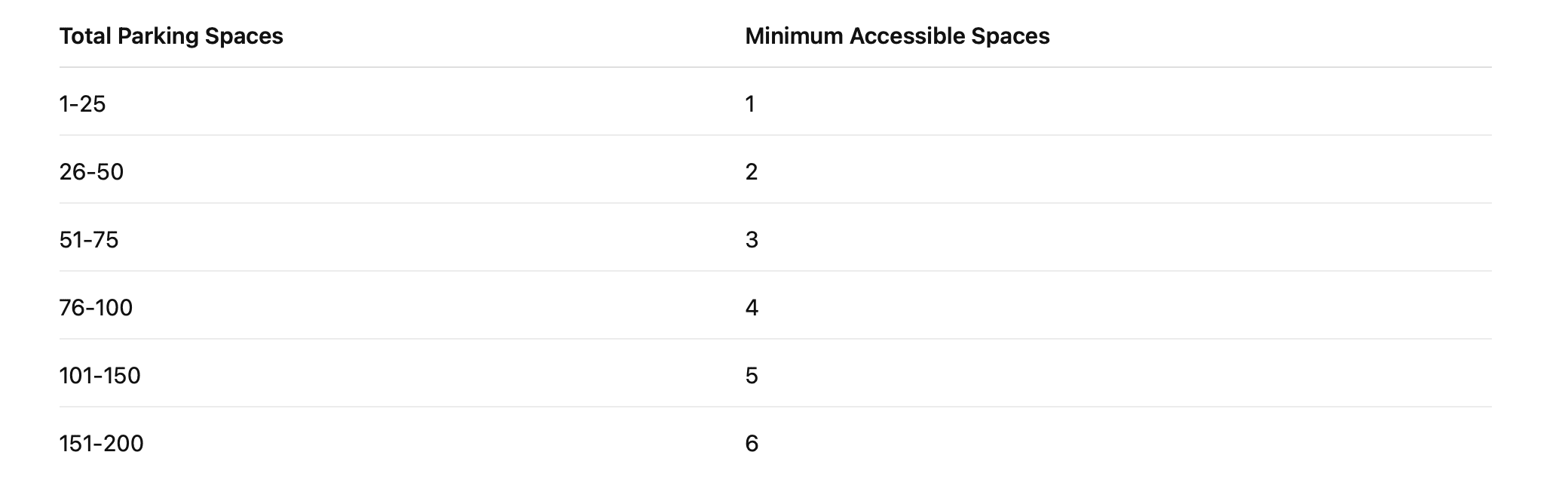
At least one in every six accessible spaces must meet van-accessible specifications, which require a wider access aisle than standard accessible spaces.
Where to place accessible spaces
Placement matters as much as quantity when following ada parking lot striping standards. You must locate accessible spaces on the shortest accessible route to the building entrance they serve. Placing spaces far from an entrance, even with correct dimensions, can still result in a violation. Key placement rules include:
- Accessible spaces must connect to an accessible route leading directly to the entrance
- Van-accessible spaces need adequate vertical clearance on the approach path
- Curbs, landscaping, or other barriers cannot block the accessible route
ADA dimensions, access aisles, and slopes
Getting the dimensions right is the foundation of any compliant striping job. The 2010 ADA Standards specify exact measurements for both the parking space and the access aisle beside it, and both must meet requirements independently.
Standard and van-accessible space dimensions
Your two space types follow different width requirements:

Standard accessible spaces require at least 8 feet of stall width with a 5-foot access aisle. Most lots use the 8-foot stall plus 8-foot aisle configuration for van spaces since it fits more cleanly into existing layouts.
Access aisle and slope requirements
Access aisles must run the full length of the parking space and connect directly to an accessible route. Mark the aisle with diagonal stripes so drivers understand it is not a second parking stall.
Never allow a parked vehicle or physical barrier to block the path between an accessible space and the building entrance.
Both the stall and the access aisle must hold a maximum slope of 1:48 in any direction (approximately 2%). Exceeding this tolerance creates a hazard for wheelchair users and puts your lot out of compliance with ada parking lot striping standards.
Markings, colors, signs, and maintenance
Correct dimensions alone don’t make a space compliant. Visible markings, proper signage, and consistent maintenance are all required elements under ada parking lot striping standards, and each one gets evaluated independently during an accessibility inspection.
Surface markings and signage
Paint color for the accessible stall is not mandated by federal ADA rules, but most jurisdictions require blue for the stall and white diagonal stripes for the access aisle. Check your state and local codes before you stripe.
Always repaint the ISA (International Symbol of Accessibility) on the pavement surface as part of any restriping project.
Each accessible space also requires a sign mounted at least 60 inches above the ground, measured from the bottom of the sign to the finished floor. Van-accessible spaces need an additional “Van Accessible” label on or below the main sign. Ground-level paint alone does not satisfy the signage requirement.
Keeping markings compliant over time
Faded paint and worn ISA symbols take a compliant lot out of standard quickly. Enforcement treats a faded symbol the same as a missing one, so scheduled restriping is not optional.
Your best approach is to build periodic lot inspections into your maintenance calendar. Catching faded lines early costs far less than redoing a full striping job after a complaint triggers an audit.
Final checks
ADA parking lot striping standards cover more than paint on asphalt. Before you sign off on any striping project, verify stall widths, access aisle dimensions, slopes, signage heights, and ISA symbols all meet the 2010 ADA Standards. Run through each element separately, because inspectors evaluate them independently, and one missing component can trigger a violation even when everything else looks correct.
Walk the lot after the crew finishes and measure before the paint fully cures. Check that van-accessible spaces have the correct aisle width and that every sign sits at least 60 inches above the finished surface. Confirm the slope with a level, and make sure the accessible route from each space to the building entrance is clear of obstructions.
If you need a professional team to handle your striping, restriping, or full lot assessment, contact Sunset Facility Management for compliant, reliable service across New Jersey, Delaware, and Pennsylvania.
How Can We Help You Today?
Reach out to us today to request a quote, ask any questions, or learn more about our services. Our friendly team is ready to assist you and provide the information you need. Let us bring a sparkle to your property!