How To Do Industrial Cleaning: Steps, Safety, And Tools

Industrial facilities, factories, warehouses, refineries, power plants, accumulate grime, chemical residue, and hazards that standard cleaning methods simply can’t handle. Knowing how to do industrial cleaning the right way isn’t just about appearance; it’s about protecting workers, maintaining compliance, and keeping operations running without costly shutdowns or safety incidents.
But industrial cleaning is a different animal compared to commercial janitorial work. It demands specialized equipment, strict safety protocols, hazard-specific training, and a clear process tailored to each facility’s unique risks. Skip any of those steps, and you’re looking at OSHA violations, damaged equipment, or worse, someone getting hurt.
At Sunset Facility Management, we’ve built our reputation on exactly this kind of work across New Jersey, Delaware, and Pennsylvania. Every member of our team is OSHA-10 Safety Certified, and we maintain a 24/7/365 Safety Director on staff because industrial environments leave zero room for shortcuts.
This guide breaks down the full process, from initial hazard assessment to final inspection, so you understand what professional industrial cleaning actually involves, what tools are required, and how to keep every person on-site safe while the work gets done.
What industrial cleaning covers and when to use it
Industrial cleaning goes well beyond mopping floors or wiping down surfaces. It targets built-up contaminants, chemical residues, and mechanical debris that accumulate inside facilities like manufacturing plants, refineries, warehouses, power plants, and pharmaceutical production areas. When you’re learning how to do industrial cleaning, you need to understand that this work requires specialized equipment, trained personnel, and hazard-specific protocols that differ completely from standard janitorial services.
What falls under the industrial cleaning umbrella
The scope of industrial cleaning is broader than most facility managers expect. Your facility may need different services depending on its industry, size, and the types of contaminants present on-site. Here’s a breakdown of what industrial cleaning typically covers:
- High-pressure washing of exterior walls, loading docks, and concrete surfaces
- Industrial vacuuming of dust, debris, and fine particulates from equipment and ductwork
- Chemical and solvent cleanup in manufacturing or pharmaceutical environments
- Tank and vessel cleaning for refineries, food processing, and chemical plants
- Floor scrubbing and degreasing of large warehouse or factory areas
- Post-construction cleanup to remove concrete dust, drywall debris, and material waste
The distinction between commercial and industrial cleaning is not just scale. It’s about the category of hazard your cleaning crew faces once they step onto the floor.
When your facility needs industrial-level service
Standard janitorial crews are not equipped to handle every environment. You need industrial cleaning services when your site involves regulated materials, heavy machinery, or conditions where contamination directly affects worker safety or regulatory compliance. Pharmaceutical plants, power generation facilities, food processing lines, and chemical storage areas all fall into this category.
Your trigger points for scheduling industrial cleaning include major production shutdowns, post-incident cleanup, regulatory inspections, and routine deep-cleaning cycles that keep equipment running efficiently and protect your workforce from prolonged exposure to hazardous residue.
Step 1. Inspect hazards and build a cleaning plan
Before any crew steps into an industrial facility with equipment, you need a complete picture of what’s on the floor. Rushing into the work without a proper inspection is the fastest way to expose workers to unknown chemical hazards, live electrical panels, or unstable equipment. This step is the foundation of how to do industrial cleaning correctly, and skipping it puts both people and operations at risk.
Conduct a site walkthrough before any crew enters
Walk the full facility yourself or with your safety lead before scheduling any cleaning activity. Identify chemical storage areas, confined spaces, active machinery, and overhead hazards during this walkthrough. Note what residues or substances are present, because your cleaning methods and PPE requirements change based on what your crew will actually encounter on-site.
Your inspection report functions as a legal document. Treat it that way from the start.
Build a written cleaning plan from your findings
Your inspection notes must translate directly into a documented cleaning plan that assigns tasks, specifies equipment, and outlines safety protocols for each zone in the facility. Do not rely on verbal instructions when hazardous materials are involved.
The plan should include a cleaning sequence that moves from high-dust areas down to floor-level work, so contamination does not spread between zones. Assign a supervisor to verify each phase before your crew moves forward.
Step 2. Set up the work area and wear the right PPE
Once your cleaning plan is finalized, control the work environment before any crew member touches equipment. A secured work area prevents contamination from reaching active production zones and keeps unauthorized personnel away from chemical exposure risks and slip hazards your team will introduce during the process.
Secure the perimeter and control access
Set clear boundaries around each cleaning zone using physical barriers like cones, tape, or temporary fencing based on the hazard level. Post signage at every entry point restricting access to authorized personnel only. Your site supervisor should maintain a log of everyone entering the zone throughout the job.
Match your PPE to the specific hazard
Understanding how to do industrial cleaning safely means selecting the right PPE for each specific task, not applying a single standard across all zones. Use this reference to match gear to conditions:
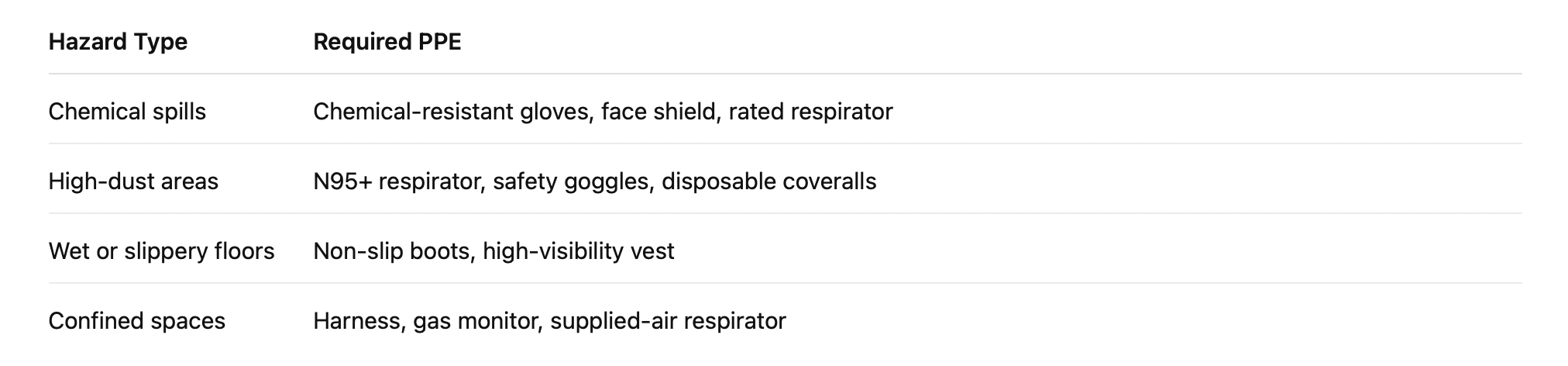
Wearing the wrong PPE is not safer than wearing none. It creates a false sense of protection that leads to direct exposure.
Step 3. Clean equipment, floors, and high dust areas
With your zone secured and PPE confirmed, your crew can begin the actual cleaning work. The sequence you follow matters as much as the methods you use when working through how to do industrial cleaning in a live facility. Always work from the highest contamination points down to ground level to prevent redistributing debris onto already-cleaned surfaces.
Start with overhead and equipment surfaces
Dust and particulate matter settle on overhead structures, beams, ductwork, and equipment housing before they ever reach the floor. Use industrial vacuums with HEPA filtration to pull fine particulates from these surfaces first. Attach extension wands to reach ceiling-level grime without repositioning scaffolding repeatedly, and wipe down equipment housing with appropriate solvent-dampened cloths rated for the contaminants present in your specific zone.
Skipping overhead surfaces before scrubbing floors guarantees your crew will clean the same floor twice.
Move to floors with the right machine for the surface
Floor cleaning in industrial settings requires matching your equipment to the surface type and contaminant present. A concrete warehouse floor with oil residue needs a different approach than a tile production area with chemical buildup. Use this reference to assign the correct method:

Document which products your crew applied to each surface type so your site supervisor can verify chemical compatibility before the next scheduled cleaning cycle.
Step 4. Handle waste, document work, and verify results
The final phase of how to do industrial cleaning determines whether your job holds up under a regulatory inspection or a client walkthrough. Improper waste disposal and missing documentation are the two most common failures that turn a completed job into a liability, so treat this step with the same rigor you gave the hazard assessment.
Dispose of waste by hazard classification
Your crew needs to separate waste streams before anything leaves the facility. Mixing chemical waste with general debris is an OSHA violation in most industrial environments and can create secondary hazards during transport.
Waste Type
Disposal Method
Chemical solvents and residues
Sealed hazmat containers, licensed disposal carrier
Industrial debris and sweepings
Labeled dumpsters, facility waste protocol
Contaminated PPE
Sealed bags, separated from general waste
Wastewater from pressure washing
Routed to approved drainage per site permit
Complete your documentation and run a final inspection
Log every product applied, every zone cleaned, and every waste container removed from the site before your crew packs out. Use a sign-off sheet that your site supervisor and the facility contact both date and initial.
A clean facility with no paper trail gives your client nothing to stand behind during a compliance review.
Walk each zone independently against your original cleaning plan to confirm the work meets the standard you committed to before the job started.
Wrap-up and next steps
Knowing how to do industrial cleaning the right way comes down to four non-negotiable steps: inspect hazards before anyone touches equipment, secure the work area and match PPE to each specific risk, clean from the top down using the right tools for each surface, and close out every job with proper waste disposal and complete documentation. Cut corners on any of those steps, and you turn a routine cleaning job into a compliance failure or a safety incident.
If your facility operates in manufacturing, pharmaceutical production, power generation, or warehousing, the stakes are too high for an unprepared crew. You need a team that is OSHA-10 certified, fully bonded and insured, and equipped to handle the specific hazards your site presents. Our team works across New Jersey, Delaware, and Pennsylvania to deliver exactly that. Contact Sunset Facility Management to discuss a cleaning plan built around your facility’s needs.
How Can We Help You Today?
Reach out to us today to request a quote, ask any questions, or learn more about our services. Our friendly team is ready to assist you and provide the information you need. Let us bring a sparkle to your property!